Friday, 1 June 2012

Post Office to introduce contactless payment

Roll out begins on 6 June across 11,500 branches, making Post Office the biggest user of contactless technology in Europe

The post office
 
Contactless technology allows customers to pay for goods by waving their card over a specially designed sales terminal without the need to input a pin Photograph: SWNS.com
People buying goods and services through any Post Office branch will soon be able to use contactless credit and debit cards and payment-enabled mobile phones.

Post Office will start to roll out contactless payment terminals across its 11,500 branches network from 6 June in a move that will make it the biggest user of contactless acceptance technology in Europe. The roll out will be complete by the end of October.

"Contactless will bring huge benefits to our customers by increasing choice and reducing transaction times," said Lesley Sewell, chief information officer at Post Office Ltd.

Contactless technology allows customers to pay for goods by waving their card over a specially designed sales terminal without the need to input a pin.

Once installed, holders of MasterCard PayPass or Visa payWave cards will be able to use the readers, along with the limited number of people with Near Field Communication (NFC) equipped mobile phones. Payments using the technology will be limited to up to £20.

HSBC recently became the latest bank to begin arming its customers with contactless cards. In May, it started a gradual roll out of such cards to customers as their current cards expire.

Barclays/Barclaycard has been the undisputed leader in contactless card provision, with almost all its credit and debit cards now contactless. Royal Bank of Scotland, which includes NatWest, has some contactless debit and credit cards in issue, while Lloyds has issued 1.5m contactless cards (including those held by Halifax customers), which will rise to 2m by the summer.

Post Office's announcement comes on the same day that internet payments giant Paypal announced it had teamed up with the clothing chain that owns Warehouse, Oasis, Coast and Karen Millen to allow its customers to pay instore using their mobile phones

From Thursday, all the four women's clothing stores owned by the Aurora Fashions Group will be equipped with scanners that can read a unique barcode generated by the Paypal inStore mobile phone app.

The app will be linked to the mobile phone owner's PayPal account and accessed through a unique Pin. Once the barcode is scanned, payment is taken from the PayPal account. The system works whether or not there is a phone signal in the stores.

"Today marks the start of a quiet revolution in the way we shop on the high street. We've created a simple, secure way to use a mobile phone to pay in your favourite stores," said Cameron McLean, managing director of PayPal UK.

Paypal has been trialing its technology in a similar tie-up with Pizza Express over the last year but it said the Aurora deal was the beginning of a bigger push on to the high street that will see it team up with more stores throughout 2012. The PayPal inStore app is available for Android and Apple iOS (iPhone and iPad) devices.

Global analysts Gartner predict worldwide mobile payment transactions will grow dramatically from $105.9bn (£68bn) in 2011 to $171.5bn this year

Wednesday, 30 May 2012

Four Mobile Payment Systems Tested and Compared

Accepting credit cards used to be expensive and complicated: You needed to set up a merchant account with a bank, you had to buy or lease a card reader, and you had to pay a setup fee, subscription fees, and fees on every sale you made. Today, a swarm of credit card processing apps for smartphones and tablets has rendered the process easier, cheaper, and highly mobile.

Four Mobile Payment Systems Tested and Compared

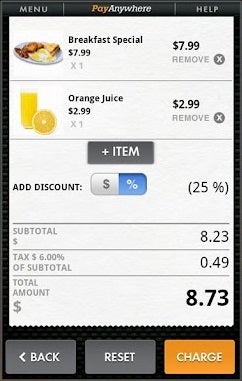
PayAnywhere has developed a strong app for its mobile card reader.Most of these mobile payment processing services offer pay-as-you-go plans, in which you pay only a fixed percentage fee per transaction. Although these fees are typically higher than what you’d pay under a traditional arrangement, these newer services can provide any small business a simple, economical way to accept payments via credit card. And instead of making you invest in an expensive card reader, these services offer free readers that can fit in your pocket or bag. Just plug one into the audio jack on your smartphone or tablet and launch the accompanying app, and you’re ready to accept credit card payments for your goods or services.

Most of these plans add value with features such an inventory system, where you can save prices and descriptions of the products you’re offering for sale. Several provide a full point-of-sale system, which enables you to attach cash drawers and receipt printers.
We examined four mobile payment processing services, along with their respective card readers and software. Each supplies an app for iOS devices (iPad, iPhone, and iPod Touch), and three of the four offer an app for Android phones and tablets, but only one service supports BlackBerry devices.

Choosing the Right Service

Accepting credit card payments can be a boon to your business, but the associated fees can be a drag on profitability. PayAnywhere’s pay-as-you-go fee of 2.69 percent per swipe is the least expensive of the four services we looked at, while Intuit's GoPayment and VeriFone's SAIL tie for second with fees of 2.7 percent per transaction. Square’s 2.75 percent fee is the highest of the four.
If you’re processing more than $1300 in payments each month, you might be better served by one of the subscription plans that combine a monthly fee with a lower per-swipe rate: GoPayment costs $13 per month with a swipe fee of just 1.7 percent, and SAIL costs $10 per month with a swipe fee of 1.95 percent.

Low transaction fees aren’t important if the software and service aren’t a good fit for your business. If you need to accept and track cash as well as credit card payments, for instance, GoPayment won’t work for you. If you need to print paper receipts from iOS devices, you should consider PayAnywhere or Square. GoPayment is the best option for printing receipts from Android devices, and if you want the ability to charge cards via a Web interface in addition to using a mobile device. If you need a synchronized database for your inventory, or if you like the idea of scanning bar codes, SAIL is a good choice.

For more information, see our in-depth reviews of the four systems:

* Intuit GoPayment
* PayAnywhere
* Square Card Reader
* VeriFone SAIL

Living on mobile money


Rory Cellan-Jones tries living without money

A couple of weeks ago I wrote about my frustrating efforts to use various new mobile money applications on my phone. I promised then to have another go, to give up cash and try to pay by phone alone. So, how did it go? Not very well, I'm afraid.

I started by loading up my phone with a variety of apps which - supposedly - would help me get by without cash or even cards. My main weapons were to be O2 Wallet and Barclays Pingit, two new services which allow you to send and receive money from your phone. But I also installed the Paypal app, and a range of others that allow you to buy a coffee or pay for a taxi from your phone.

Within minutes of starting, I ran into trouble. It was my turn to buy the office tea and coffee round, and the coffee outlet only took cash. No problem - I would get my colleague Anthony to pay and refund him via one of my mobile money pay-by-text services.

With Barclays Pingit playing up (I never got it to work, even after deleting the app and going through the lengthy verification system again) I turned to my O2 wallet. Just two or three passwords later, I had texted a £2.80 money message to Anthony.

Starbucks coffee Coffee and taxis worked. Other items... not so much

Then the fun began.

He spent days - quite literally - trying to make sure this and a couple of other payments from me made their way from his phone into his bank account. Much of that time was spent in increasingly intemperate phone conversations with O2. At one point the company told him their "triage unit" was on the case. Anthony's verdict? "No need for triage - it's terminal!"

I quickly realised that although I wanted to rely solely on my phone, this approach wasn't going to work. I would need to use credit and debit cards as well, plus my Oyster touch-and-go card for travel around London.

By paying for meals via my debit card - which meant I had to spend more than £5 - I did manage to get by without cash for a couple of days.

Then I took a trip to Oxford and had my first failure.

Getting on a bus to the city centre without a travelcard, I found myself obliged to dip into my pocket for some coins to pay the fare. And my bus trip proved a timely example of how useful mobile money could be if it were more widely adopted. On a busy route, every time we stopped dozens of school children and students queued to pay by cash, making our progress very slow.

While neither of my mobile money services proved at all useful over the week, there were two things - taxis and coffee - that proved easy to pay for by phone. The taxi app market is now fiercely competitive and I found Hailo, a service that lets you order a London cab, pretty efficient at delivering a driver to me within five minutes.

Rory's bus ticket Paid for in cash

I also tried Ubicabs to order minicabs, and this again worked fine - although my driver ended up asking me to navigate to my destination. These services make it very easy to move around without cash or credit cards - if only in the London area - but they have one major downside. You end up racking up big bills without even thinking about it.

The same applies with the Starbucks app, which allows you to load money onto a virtual payment card on your phone, then swipe your phone against a reader to pay for coffee or a sandwich. Because this was the only easy way I found to buy food from my phone, I ended up spending far too much on cappuccinos.

When I ended my experiment, I breathed a sigh of relief - as did my colleague Anthony, who is still trying to extract from his phone the money I owe him. Trying to live off mobile money, which is supposed to make life easier, has been a stressful experience. The inevitable concerns about security are making most of these new services so complicated to use that you have to be slightly deranged even to bother.

That is not to say the whole idea is doomed to failure. We will see further innovation over the coming weeks as payments firms unveil plans to allow visitors to the London Olympics to pay with their phones.

But here's my advice to the companies pushing these services - your "triage units" are in for a busy time.

Elavon launches chip and pin mobile POS solution, MobileMerchant


Sensitive data is captured and encrypted using a Bluetooth connected PIN pad


Elavon, a payment solution provider wholly owned by US Bancorp, is rolling out MobileMerchant, a new mobile POS solution that supports chip and pin as well as magnetic stripe cards and card-not-present transactions (view press release). The launch follows a successful pilot stage which began in January of this year.

The solution enables mobile merchants to take card payments on the go by downloading an app and inserting a plugin chip and pin reader into their smartphone. All sensitive data is captured and encrypted using a Bluetooth connected PIN pad so no data is ever stored on the device. Following the transaction a receipt is sent to the customer by email or text message. Debit and credit card transaction data can be accessed and analysed via an online data management system through which merchants can also run transactions using a secure Virtual Terminal application contained on the portal. The solution is currently available for devices running on Blackberry and Android.

Elavon is launching the product in partnership with specialist payment gateway and EMV chip technology provider, CreditCall. MobileMerchant is supported by CreditCall’s CardEase Mobile technology.

Global mobile payment revenues to surpass USD171.5 billion this year


Mobile spending expected to increase 61.9% year on year


Global mobile payment revenues will top USD171.5 billion this year, according to a new forecast from Gartner, as consumers increasingly use smartphones and NFC-enabled devices to pay for goods and services. The research house estimates spending will increase 61.9% year on year from USD105.9 billion in 2011, driven by purchases via mobile storefronts or using mobile payment technology in-store. Gartner expects the number of consumers using the technology worldwide to increase from 160.5 million last year to 212.2 million by the end of 2012, boosted by the penetration of mobile devices and the glut of payments services available on the market.

Merchants will lead the consumer migration towards mobile payments in Europe and the US over the next few years, according to Gartner. This will combine both e-commerce purchases and mobile payments in store, with big name early-adopters such as Starbucks leading others. The coffee shop chain says that it processed USD26 million in mobile payments via its Mobile Pay app for devices running on iOS and Google’s Android operating system last year alone. PayPal is also making major inroads into the space as it attempts to replicate its success in online payments to mobile, recently partnering with 15 major retailers including Abercrombie & Fitch and Toys ‘R’ Us to roll out its mobile payment terminals in-store.

Gartner predicts that as the mobile payment market expands, it will fragment into a raft of different services and solutions as payment firms tailor their products to local demands. SMS payments will continue to dominate in developing markets, as the penetration of internet-connected devices remains low compared to key markets such as the UK, where more than half the population now own smartphones. In the US, however, the firm forecasts that 88% of all transactions will take place online by 2016. Despite the hype surrounding NFC technology, Gartner forecasts that it is still a few years away from becoming mainstream, with the number of handsets supporting the technology still relatively low and Apple yet to launch an NFC-enabled iPhone.
NFC payment involves a change in user behaviour and requires collaboration among stakeholders that includes banks, mobile carriers, card networks and merchants,” says Shen. “It takes time for both to happen.”

Rising global demand suggests that even as major payment services such as MasterCard’s PayPass and Visa’s V.me compete with each other for user loyalty, there is still space for dedicated firms such as Square or iZettle to grow. “There will be a few global players that have the scale and resources to serve large customers and the mass market whose requirements can be readily satisfied by standard solutions,” says Gartner analyst Sandy Shen. “However there will always be segments that cannot be sufficiently served by the global players.”

Monday, 28 May 2012

Groupon tests new service, enters mobile payment battlefield

Groupon mobile payments

Groupon, the daily-deals company, is testing out a new mobile payment system that puts it in competition with Square and PayPal. (Charles Rex Arbogast / Associated Press / May 26, 2012)

Groupon has begun testing a mobile credit card reader, encroaching on a domain innovated by Square that PayPal has also recently entered.
The Groupon payment platform will charge a 1.8% transaction fee along with a 15-cent transaction charge. At that rate, the fee is less than Square's 2.75% or the 2.7% charged by PayPal Here and Verifone SAIL, another player in the market. However, Groupon's competitors don't have a transaction fee.

Groupon is giving the card readers away free to merchants along with an iPod Touch, according to VentureBeat That's more than Groupon's competitors, which just hand out readers.
The reader itself is a case that wraps around the phone, unlike the readers used by Groupon's rivals, which connect to mobile devices only through their headphone jacks, according to a Reuters report.
The Groupon mobile payment system was first reported on by VentureBeat, which said it was forwarded an email by a business that was solicited by Groupon for the service.

The mobile card reader for Groupon, which specializes in daily deals, is a money saver for merchants when it comes to high-priced transactions, due to the lower fee. But for smaller purchases the other platforms are more economical for businesses.

Friday, 18 May 2012

Mobile Payment Acceptance Security fact sheet

PCI Council Releases Tip Sheet for Tablet POS


The PCI Security Standards Council (PCI SSC), a global, open industry standards body providing management of the Payment Card Industry Data Security Standard (PCI DSS), PIN Transaction Security (PTS) requirements and the Payment Application Data Security Standard (PA-DSS), has published a customized fact sheet outlining how merchants can securely accept payments using mobile devices such as smartphones or tablets.
The At a Glance: Mobile Payment Acceptance Security fact sheet provides merchants with actionable recommendations on partnering with a Point-to-Point Encryption (P2PE) solution provider to securely accept payments and meet their PCI DSS compliance obligations.
The ability to use smartphones and tablets as point-of-sale terminals to accept payments in place of traditional hardware terminals offers great flexibility. As mobile technology continues to change at a rapid pace, the Council continues to work with the industry to ensure data security remains at the forefront of mobile evolution.
This latest educational resource is the product of the Council’s Mobile Working Group and is the result of valuable input from leading merchants, vendors and organizations actively involved in the in the mobile payment acceptance industry. The document helps clarify and distill some of the more complex technology and security terminology into straightforward, practical guidance that can help merchants to:
* Better understand their responsibilities under PCI DSS, and how they translate to mobile payment acceptance

* Leverage the benefits of the Council’s recently published Point-to-Point Encryption (P2PE) standard and program

* Choose a mobile payment acceptance solution that complements the merchant’s PCI DSS responsibilities, for example a P2PE solution provider
The fact sheet also draws on recent updates made to the PIN Transaction Security (PTS) Requirements at the end of 2011, creating the foundation for data security in mobile payment acceptance.
Using this resource to guide them in how PTS and P2PE standards work together, merchants can better understand how to securely use external plug-in devices with smartphones or tablets to accept payment cards by first encrypting and securing the data at the point that the account data is captured. The smartphone or tablet has no ability to decrypt the data, thus simplifying PCI DSS scope for the merchant.
“We know merchants are eager to take advantage of their existing smartphones or tablets to accept payment cards,” said Bob Russo, general manager, PCI Security Standards Council. “And the Council and its stakeholders want to help the market to do this in a secure way. We’re excited about this easy-to-use reference that will help merchants understand how to use the suite of PCI Standards to enable their businesses while still keeping data security top of mind.”
As with all SSC fact sheets, this guidance does not replace or supersede any of the PCI Standards. The Council continues to work with the payments community to address mobile payment acceptance security and evaluate whether additional requirements are needed in this area. As part of this ongoing initiative, the Council plans to publish best practices for securing mobile transactions later this year.
“The PTS and P2PE standards are being leveraged by mobile solution providers today. With this fact sheet we hope to help merchants understand how these standards work and the options that are available to them for accepting mobile payments in a secure and PCI DSS compliant manner,” said Troy Leach, chief technology officer, PCI Security Standards Council.

Thursday, 17 May 2012

iZettle mobile payment app and dongle comes to the UK

iZettle, a new mobile payment solution, has arrived the UK. The dongle, which attaches to the iOS device, reads your card like a chip-and-pin machine and allows you to sign for goods
The Square mobile payment company, from Twitter founder Jack Dorsey, has revolutionised the idea of mobile-based payments in the US by allowing businesses to accept card payments, quickly, easily and cheaply.

The little white dongle, which can be attached to iPhones and iPads where there's mobile data connectivity, allows the vendor to swipe the card, enter the amount and pass over to the user to authorise.

With Sqaure, or rival company PayPal Here, still to reveal when they might be crossing the Atlantic, a new European-based solution is coming to the UK.

The iZettle company, which has already earned some success in the Nordic region, is launching a free dongle and software to 3,000 invited businesses in the UK and is aimed at supporting those small companies that have never accepted plastic before.
So, it could be perfect for market stalls, taxi drivers, roadside cafes, t-shirt sellers at concerts and more. According to Jacob De Gaer, the company's CEO, there are 20 million businesses in Europe that fit into this category.

Unlike Square, which swipes the magnetic strip on the card, iZettle's is a solution more akin to the UK's chip-and-pin infrastructure. The dongle fits into the charging port and the card is simply inserted. Users will then be asked to sign the screen with their finger before the transaction is completed. For its troubles iZettle takes a small commission from the payment, but that won't cost users a penny.

The service is for iOS initially, but the company promises an Android solution soon. Interested businesses can download the iPhone app and register. The app features the ability to itemise the inventory's so businesses can keep track of exactly what they sell.
Whereas NFC has is still in the early stages of its development, services like Square have been massively successful in the United States. It'll be interesting to see how iZettle's solution performs on these shores.

Thursday, 3 May 2012

Push NFC


Report: Vast Majority of Consumers Will Need Push to Use NFC Payment


Fewer than 2% of consumers are “highly likely” to adopt NFC payments immediately after the technology is rolled out, according to UK-based research firm Datamonitor.
 
The firm, in a recently published report, projected that another 12.2% of consumers have a medium likelihood of adopting NFC payments right after it’s introduced and more than 31% have only a low likelihood of using the technology for payments in the short term. The remainder of consumers–more than half–are considered “unlikely” to adopt NFC payments, said the firm.
Except for consumers who are highly likely to embrace NFC payments, issuers, mobile-wallet providers and others introducing NFC payment services will need to offer incentives to consumers to encourage them to adopt the technology, and this adoption will likely take longer, said Datamonitor in its report, NFC Payments.

‘Breathless PR’

The firm notes that there is debate over whether NFC will break through to mainstream consumers this year or in 2012. But there is little discussion about what actually constitutes a breakthrough.
“While the hype continues to grow, and the breathless PR statements of excited executives enter into circulation, little attention has seemingly been paid to who are the consumers most likely to adopt NFC,” said the firm in its report. “While mobile phone technology has progressed rapidly over several years, and Internet usage increasingly becomes mobile, this does not necessarily mean that consumers are clamoring for NFC.”

The research firm based its predictions of how likely consumers are to adopt NFC on three indicators–how much the consumers now use mobile banking and contactless cards or are interested in these technologies, and how frequently they use conventional payment cards to make retail payments.
This data comes from Datamonitor’s 2010 global Financial Services Consumer Insight Survey, which polled more than 12,000 consumers online in more than 15 countries. The large annual survey covers a range of financial services, including retail banking, cards and payments and insurance.
Consumers in a given country would be considered highly likely to adopt NFC if they said they use or show interest in mobile banking and contactless payment, and if they also use conventional cards frequently for retail payments, said Datamonitor.

Consumers who fall into two of the three categories are considered to have a medium likelihood of adopting NFC. And if they fall into only one of the categories, Datamonitor would classify them as having a low likelihood of adopting NFC immediately.

Most consumers surveyed–at 54.3%–do not use mobile banking or contactless cards and do not use conventional payment cards frequently so are considered “unlikely” to adopt NFC payment initially. That figure is likely to decrease over time, however, with use of smartphones growing rapidly and more contactless payment cards and terminals becoming available, the firm said.

Using this “NFC Adoption Model,” Datamonitor gave the highest score to Brazil, where the report estimates 5.1% of consumers are highly likely to adopt NFC, followed by South Korea at 4.2% and Singapore at 3.9%. By contrast, only 0.4% of consumers in the Netherlands and Italy are highly likely to adopt NFC in the short term, according to the model. Surprisingly, the United States comes in at only 0.5% of consumers being highly likely to adopt NFC.

The high score in Brazil appears to be an anomaly, since the penetration of all types of payment terminals is relatively low. Datamonitor explains the score by saying mobile banking and other mobile-money services, such as remittances, are on the rise there.

“(And) many consumers there are keen to switch to cashless payments, and where consumers do have payment cards, including prepaid, these tend to get used very frequently, which helps to drive up their overall likelihood of NFC adoption,” said Gilles Ubaghs, senior analyst for cards and payments at Datamonitor.

Early Adopters Not the 18-to-24 Crowd

While small, at 1.8%, the highly likely adopters across all countries still are a potentially lucrative segment for NFC service providers. They tend to be older and have more money than might be expected, said Datamonitor.

Just under 37% of the consumers in this highly likely category globally are between the ages of 35 and 49 and another 33.8% are 25 to 34. About 16% have incomes placing them in the top quarter of respondents, and 44% have an income level in the top half, said the firm.

Datamonitor acknowledges that basing its projections of adoption of NFC payment on existing use or interest in mobile banking, contactless payment and frequency of use of conventional payment cards is not precise and is only “indicative” of the likelihood that consumers will use their phones to tap to pay.

But there is little solid data on which to base the projections for NFC adoption among consumers, notes Ubaghs. That includes a lack of meaningful data from the results of numerous NFC trials conducted over the past few years, he contends.

“Our view is that there is quite an irony in the fact that many in the industry take it as a given that consumers want to use mobile payments and point at trial results as proof that consumers love it,” he told NFC Times. “In all these trials, consumers were given an incentive to use these phones and take part.”

Incentives Required for Adoption by Masses

That includes such high-profile NFC trials as one launched in late 2007 by Telefónica (O2) UK, Barclaycard and Transport for London, which gave users in London spending money preloaded on the phones. Citigroup in Bangalore, India, held a large trial in 2009, in which it gave participants a chance to get the phone they used in the pilot for free if they conducted just a dozen transactions.
“If people are effectively being paid to use something in a trial, it’s not surprising that results are so positive,” said Ubaghs. “The groups conducting these trials then state that they had to provide incentives to get people to participate, but that stands for the real world as well. It strikes me as a bit of a myth that seems to keep circulating that consumers are clamoring for it.”

He also pointed to the NFC commercial payment services launched by Barclaycard and Orange UK in May, offering consumers £10 (US$16.07) cash added to their prepaid mobile payment accounts upon activation. And users can receive 10% cash back on all purchases made with the phone in the first three months. This generous offer is designed to encourage users not predisposed to use the technology to give it a try.

In addition, NTT DoCoMo reportedly saw significant gains in use of its contactless wallet phones by Japanese consumers after introducing contactless-mobile couponing. The response of Japanese consumers to contactless m-payment by itself was lackluster for years following the rollout of wallet phones, launched by DoCoMo in 2004.

The Datamonitor report overall states that there is a large opportunity for NFC service providers to encourage consumers to use NFC outside of the highly likely category–especially among consumers in the medium and low likelihood categories. And the NFC payments ecosystem is finally gearing up, with NFC handsets and mobile wallets launching this year, the report notes.
But the task of persuading most users to change their habits and to tap NFC phones to pay will not be easy, said Datamonitor.

“The market faces significant hurdles in convincing issuers, consumers, and merchants of its benefits,” said firm in a statement. “The business case remains ill-defined for both issuers and merchants, while consumers will need a strong proposition to shift them from existing, readily available payment tools. Without all of these elements in place, the deployment and wider development of NFC will be difficult.”

Wednesday, 2 May 2012

Tight - Loose - Tight

“A leader is best when people barely know he exists, when his work is done, his aim fulfilled, they will say: we did it ourselves” Lau-Tzu 600 B.C.

Let's look at the difference between Leadership and Management, and why it is crucial to focus on both to become the extraordinary enterprise, rather than just run-of-the-mill.

To some people leadership looks and feels natural, but the confidence to lead is not inbuilt. That confidence did not just appear. Since childhood the “natural” leader has been trying things out, and getting things wrong, half right or perfect over many years before assuming a position in which they obviously feel comfortable but probably never analysed to any great degree; to them its just the way it is. And of course whilst they might be good at painting the forward looking picture of the organisation, and “leading from the front” they may be incompetent at a whole range of things that equally need doing just as urgently.

This is where the power of the TEAM comes in. Many business leaders find themselves in leadership positions unexpectedly, and feel that they are ill-prepared for the task ahead, but not being the “natural” leader should not be a hindrance to leadership success in the extraordinary enterprise.

It is recognising that for each employee the level of leadership that is needed is different that makes the great leader. It is understanding that in any organisation it is the TEAM and its power when harnessed correctly and not wastefully that determines extraordinary performance, not the clinging to the details oneself. And in the many different teams that make up the enterprise, it is giving permission to team managers and members to take leadership responsibility, again that word EMPOWERMENT, that delivers extraordinary performance.

And once the team has been given permission to lead it is the overall leaders task to communicate to all the members of the enterprise who is doing what, why and to whom and for whom. Just because others have permission to lead does not mean laissez faire management. It means that true delegation with responsibility is in place, and the Leader can devote time to other tasks.

Payment News - Runners & Riders

Mobile Movers, Shakers and Shockers

by Karen Webster

     
I don’t know about you, but 2012 so far has left me a little breathless given the fast pace at which the payments industry has been moving since we all emerged from the New Year’s break. Maybe it’s the mild winter. No matter, the catalyst, not surprisingly, is mobile and the IP-enablement of just about everything that touches or influences commerce. This last week was particularly interesting given a few announcements from very different corners of the payments ecosystem about their payments strategy, not surprisingly, keyed to what they will pursue (or won’t) along the mobile lines. Here’s my take on mobile movers, shakers, and shockers.

Movers
Visa announced that it will enable FIs to more easily enable the delivery of mobile financial services solutions to their customers. This mobile banking/payments platform capability is courtesy of its alliance with and equity investment in Monitise, a UK-based technology and services company that has a pretty powerful and proven mobile banking and payments engine. This new Visa capability will allow FIs to extend a variety of useful financial services to their accountholders including balance checks, funds transfers, and transaction alerts. As a purely B2B play, it didn’t get as much airtime as the stuff that is more consumer directed but is interesting nonetheless. It puts Visa right smack dab in the middle of same competitive playing field as Fundtech, Sybase, mFoundry and others who have built their businesses by allowing FIs to deliver banking services via the mobile phone. Visa can now use its powerful FI channel to distribute this capability and to do it worldwide. There was no reference made to the business model that Visa will use as part of its go to market strategy, but one can imagine that it could create a disruptive model given their long-standing FI relationships and the other revenue possibilities that this platform can generate for them.

This move could also be an interesting way to “back door” a variety of mobile payments capabilities that carry the Visa brand without the heavy lift associated with going direct-to-consumer. As the largest global payments network on the planet, Visa has the benefit of global brand awareness and acceptance but it lacks a direct relationship with the consumer. As a platform and absent those direct consumer relationships, it also faces a strategic conundrum in how to capture more transaction share and revenues since it is completely dependent on its distributors and merchant partners to do that for them. Enriching its platform with more capabilities that allow its “distributors” to add more value to its customers seems like a sensible move. It not only adds value to their customer – and their customers customer – but it rings the cash register at a much higher margin – the “distributors” are the ones that do the heavy lift with getting consumers to adopt. And, once these mobile banking and payments hooks are in place via the FI accounts, Visa all of a sudden has a worldwide mobile network of consumers that it can touch, via the platform, with other services like offers, coupons, and who-knows-what else. Visa has been criticized for being slow moving in the mobile world, and while this announcement certainly does not conjure images of “cool and nifty”, but if my assessment is correct, it seems a strategic and methodical approach to creating a mobile commerce capability that it can finally, ahem, monetize.

Shakers
Facebook has been making a ton of news lately, not the least of which is its S1 filing and all of the juicy tidbits that it revealed about its payments ambitions. [Check out David Evans article which provides insight and analysis.] But, it was its agreement with Bango last week that really got tongues a waggin’.

Bango does two things in the mobile payments space: it integrates with mobile operators’ billing systems so that consumers can buy mobile apps and have those charges show up on their mobile phone bills and it collects and provides data on mobile content usage. Facebook has 425M+ people around the world accessing Facebook via the mobile phone. It is increasingly worried that as more consumers access Facebook via mobile, that its ad revenue will plummet unless it figures out a way to monetize eyeballs that move from online to mobile. It’s a tricky proposition for them. Lots of brands – and mobile operators - have experienced the backlash from users who hate being bombarded by ads popping up on a small mobile (or tablet) canvas. Sponsored stories or similar strategies (a la what Twitter has done) are rumored to be in the offing for Facebook, but that alone won’t really help Facebook capture the revenue it needs – and frankly should be able to get – from the mobile channel.

Enter Bango, potentially. I don’t think that Facebook will use Bango to create its own payment network on Facebook, although I guess anything’s possible. It seems like it would be an awfully big an investment just to make money from moving transactions thru the system. Rather, Bango is likely to be used by Facebook to accelerate the adoption of a new monetary network using Facebook Credits as the currency to effect commerce transactions. Think about it. It’s been reported that one in every three Facebook mobile users uses the mobile phone to play games. Using Bango, Facebook Credits and the carrier billing channel, Facebook could flood, okay maybe just increase, the number of Facebook Credits in the system which Facebook monetizes by taking 30% of whatever Facebook Credits when businesses or people try to cash those Credits for government-issued tender.

It is a pretty sweet set up. Every $1 of Facebook Credits means 30% back to Facebook at some point down the road when those Credits are pulled out of the Facebook network. One might imagine mobile operators using Facebook Credits as a currency to pay developers who are, in turn, being paid via Facebook Credits when consumers buy their apps. At some point, those Credits will be “cashed in” and the 30% tax will be directed back to Facebook, but until then it is sort of like there is this little alter-monetary system happening all around us that is fueling commerce on a massive social and soon to be commerce platform, the Facebook way.

This mobile payments strategy cum-Bango also shifts the risk of chargebacks to the carrier, who probably bears little risk anyway since the transaction amounts are relatively small and the last thing people these days want to risk is having their phones shut off for non-payment. And those 30% “taxes” are pretty high margin to boot.

This whole scheme is made all the more powerful when you consider it on a global basis, where not now, but soon, most everyone in the world will have a mobile device and be able to connect to the internet via that device. Facebook, with its ~1 billion users today, is likely to capture many billions more as consumers in developing markets begin to use their phones to interact with this social platform. Once this happens, Facebook will see even more enormous growth - for instance, in spite of having an enormous user base in India, less than 4% of its population is on Facebook. Once that happens, Facebook will have a mechanism in place to monetize on the interactions of its consumers with the apps on its platform via a payments network that is already in place – the mobile carrier and a monetary system that they control - Credits.
Talk about shaking up the ecosystem. Now we know at least one other reason why Facebook’s IPO value is in the $100B range.

Google
Google’s a shaker for a totally different reason. The news last week was all about the reported ease with which Google’s Wallet could be hacked – and was. Reports suggested that if one’s phone is lost or stolen, all a bad guy has to do is to go into app settings, clear the data and reset the PIN. Now, that of course only applies to the universe of people with (a) a Sprint Galaxy Nexus 4S and (b) a Google wallet account which is still a pretty small universe. But it is unsettling particularly given the dust up in December over Verizon’s decision to block Google wallet from its Galaxy phones over security concerns. [See my commentary on that announcement here.] My take on that decision was that it was likely motivated over control of the wallet, but maybe their concerns were rooted in real security issues after all. This news also comes on the heels of recent reports of a pretty lackluster reception to Google Wallet in the marketplace as a result of many things – its NFC POS requirements, its demand for SKU level data from merchants and lack of a compelling value proposition for consumers (not many phones avaiable to acces Google Wallet and not many places to use it if you had it).

PayPal
PayPal made big news last week when it totally confirmed what eBay CEO John Donohue said about NFC some time ago .. .and that is that it stands for “not for commerce.” On Thursday, PayPal went on the public record to say that it was ditching, um discontinuing, its efforts involving mobile payments at the Point of Sale via NFC. The reason? Not enough merchant interest to continue. It seems that PayPal’s other POS innovations were far more interesting to them since they create less disruption at the point of sale (and don’t even require mobile phones to access PayPal accounts) and therefore a whole lot easier to implement and get traction. We’ve talked to a bunch of merchants who still want to see more of what PayPal has to offer but who admit to being intrigued by its frictionless POS experience and the prospect of enabling the PayPal account base on their behalf.

We’ve said before that PayPal has made a bunch of really smart moves, backburnering NFC as just the latest example of that, and is doing some interesting things to enable the convergence of on and offline commerce that will reinvent commerce at the physical point of sale. But, it ought to keep a close eagle eye out on its Silicon Valley neighbor Facebook, now that it will soon come under public pressure to deliver shareholder returns and sees payments as one of the ways to do that. Facebook, just by its sheer reach of consumer eyeballs, is in a great position to create an alternative online and mobile payments network but not in the same way PayPal has.

Instead of creating an alternative acceptance mark Facebook could force the adoption of an alternative currency on those channels that uses other funding sources to enable payment on its social platform. As more and more eyeballs and commerce move to the Facebook platform – which we believe it will in the next several years – it could more plausibly become a ginormous payments network without any of the investment required to build one and without getting into the risk and risk management business just by controlling the monetary supply, if you will, for enabling commerce on that platform. If it does, it could turn the online and mobile payments business model upside down by making its money, in effect, on currency conversion and not payments transacting.
Oh, and I am totally invoking my right to say I told you so on the whole mobile payments/NFC front. For those of you who haven’t read all of my NFC rantings, a few of the more recent ones are here. I don’t know about you, but I can’t wait for this week to see what else is in store!

Thursday, 26 April 2012

O2 launches mobile wallet

26 Apr 12 - Author Editorial - editorialUK

The O2 wallet
Last night O2 launched the O2 wallet at the Wayra Academy in London, enabling people to send and receive money, compare prices and shop via their smartphone. The service is available to everyone, not just O2 users, and incorporates the following features:

  • Money Message: transfer money to another UK mobile phone number via SMS. Sums of between GBP1 and GBP500 can be transferred daily.
  • Shopping via mobile: a mobile barcode and search engine function allow users to scan items in-store and compare prices with around 100 online retailers. The feature also offers daily deals via a ‘My Offers’ icon which include discounts at retailers such as Debenhams, Comet, Sainsbury’s Direct and Tesco Direct.
  • Mobile wallet: card data can be digitised and stored in the O2 Wallet to make mobile payments. Funds can be loaded onto the wallet via debit card, Money Message or with cash at around 30,000 locations including O2 stores, PayPoint and epay retail outlets. Users can access a 30 day payment history through the app and text alerts can be set up to notify the user of changes in account balance. The wallet doesn’t yet incorporate NFC technology but this is to be added in due course.
  • O2 Money Account Card: a physical and virtual O2 Money Account Card is provided on a Visa prepaid account. The virtual card can be used for online shopping whilst the contactless physical card can be used on the high street and at ATMs.

The O2 Wallet is compatible with smartphones and the iPad, non-smartphones with web browsers can also take advantage of certain features such as Money Messages. According to O2, the amount of people using mobile banking rose from 9.7% in 2010 to 20.4% in 2011, and mobile shopping is expected to increase by 53%over the next twelve months to hit GBP4.5 billion, making the Brits the biggest mobile shoppers in Europe.

Friday, 20 April 2012

PayTag

Image1
 
Barclaycard has unveiled a stick-on credit card called PayTag, which will sit on the back of a mobile phone (or any other item you carry everywhere) and then be used to make small, contact-free payments.

The tiny sticker, which is about a third of the size of a traditional credit card, uses near-field-communication technology to transfer cash from your bank account to a contactless payment terminal. You just wave your device over the terminal, and you don't need to enter your PIN.

The idea is to open mobile payments to Barclaycard's 12 million customers, even if their mobile phone is not equipped with an NFC chip, or not set up for contactless transactions. Or even if they don't have a phone at all -- the sticker works on anything.

Right now, the sticker can be used to make payments of £15 and under, and it will rise to £20 in June 2012. That means it's suited for buying lunch, coffee, magazines and other bits and bobs. As such, retailers like Pret a Manger, McDonald's, Boots, WH Smith and Tesco are among the first to offer contactless payments.

Barclaycard's PayTag will launch in May, when a select group of its credit card customers will receive a sticker in the post. Later this year, all customers will be offered the free upgrade.

PayPal attacks Square & iZettle

More Than 200K Merchants Have Signed Up For PayPal Here

      
PayPal
During eBay’s earnings call today, eBay CEO and President John Donahoe said that over 200,000 merchants have signed up for PayPal Here, the company’s Square-like mobile payments hardware and software platform for small businesses. We haven’t seen any sign-up numbers for the mobile payments service since PayPal revealed it was seeing 1,000 new registrants per hour for the new service.

As you may have heard, PayPal Here offers a triangular add-on that plugs into the headphone jack on your smartphone. Merchants can then accept payments by swiping cards with the thumb-sized card reader or can use the smartphone’s camera to scan credit cards (powered by Card.io), scan checks, etc. PayPal Here offers a flat rate of 2.7 percent for card swipes.

Donahoe says the reader will launch to the public in the second quarter, and will be available in the US, Canada, Hong Kong and Australia at launch. He adds that he’s not sure they can manufacture enough PayPal Here devices to keep up for demand.

For basis of comparison, over 1 million merchants currently use Square to accept credit cards (which is a data point that was released in December, so this number could be higher).
Donahoe also said during the call that eBay would be improving the marketplace checkout experience, search and discovery on the platform. With regard to NFC, Donahoe says that it will be at least a couple of years before you see adoption of NFC at large retailers.